What a Wwft-compliant file looks like
An overview of file components for identification, UBO checks, risk classification and the acceptance decision.

In the complex landscape of financial regulation in the Netherlands, the Money Laundering and Terrorist Financing (Prevention) Act (Wwft) is central to protecting our financial system. As part of your organisation, large or small, you play a crucial role by building effective Wwft compliance files. This is not a simple checklist; it is a dynamic process requiring continuous attention and adjustment. This article helps you understand that process so that you can ensure every component is specifically tailored to your organisation's needs and risks.
1. Identification and verification
A Wwft-compliant file starts with identifying and verifying the customer. This means the customer has introduced themselves and presented the necessary information.
Identification: natural person
A Wwft-compliant file begins with thoroughly identifying the customer. This involves obtaining relevant information such as:
- name
- address
- date of birth
- nationality
- identification number (passport number or citizen service number)
Record these details in your file.
Verification: natural person
Next, it is essential to verify the information provided to confirm the customer's identity. This can be done by checking various documents, depending on the nature of the business relationship and the customer's risk level. Typical documents used for verification include:
- passports
- driving licences
- identity cards
- recent utility bills.
The aim is to check these documents' authenticity to prevent identity fraud and establish a high degree of certainty that the person claiming to be the customer really is who they say they are.
Verification of a legal entity
A Chamber of Commerce (KVK) extract can be used to verify a legal entity. This allows you to establish that you are dealing with a company that actually exists.
Collect for your file:
- extracts from the KVK register, or a Chamber of Commerce document for foreign legal entities.
In person or remotely?
When you meet your new customer in person, you can easily ask for identification documents and make copies of them.
The meeting may take place digitally rather than in person. In that case, additional steps are needed to check identity documents for authenticity. You can:
- ask for a copy of the identity document by email
- schedule a video call with the customer. This allows you to see immediately whether you are dealing with an actual living person.
- take a screenshot of the customer during the video call, clearly showing both the customer and the identity document and its details.
Collect for your file
In person:
- A copy of the identity document that you made yourself.
Digitally
- A copy of the identity document forwarded by the customer.
- A screenshot showing the customer and a clearly visible identity document.
Please note!
Do not accept copies of identification documents. Always make a copy yourself for your file.
Ultimate Beneficial Owner (UBO)
When dealing with a business customer, you must establish the UBO. The UBO is the organisation's Ultimate Beneficial Owner. A UBO can be recognised by the following characteristics:
- A person holding more than 25% of the shares;
- A person with more than 25% of the control;
- The UBO is always a natural person.
Finding the UBO also depends on the organisation's legal form:
- Sole proprietorship: the owner is the UBO.
- General partnership (VoF): all partners are UBOs.
- Professional partnership (maatschap): all partners are UBOs.
- Private and public limited companies (BV and NV): not possible through a database, so use an alternative method such as a UBO declaration.
UBO declaration
A UBO declaration contains personal details about an organisation's UBO, such as their name, date of birth, nationality, residential address, and the nature and extent of their interest in the company. The UBO verification process requires organisations to identify and verify their ultimate beneficial owners. Until recently, the UBO also had to be registered in the UBO register.
UBO register
The situation surrounding the UBO register is currently somewhat more complicated. The UBO register was created to make UBO registrations accessible, but has no longer been public since 22 November 2022 for privacy reasons. It is also no longer possible to request a KVK extract from the UBO register.
Collect for your file
- UBO register extract
- Printout of KVK group relationships
- KVK register extract
- Completed UBO declaration
2. Risk assessment
Conducting a risk assessment helps you evaluate your potential new customer. You can use it to decide whether to enter into the business relationship. The aim is to learn more about the customer and determine whether they may be involved in money laundering. Check the following:
- Politically exposed person (PEP) status;
- Entries on sanctions lists;
- Other risks.
PEP
A PEP, or Politically Exposed Person, presents considerable risks because of their position. People in these roles may be susceptible to bribery and consequently have links to money laundering. It is therefore important to investigate every customer thoroughly, since there is no central source listing all PEPs.
Collect for your file
5 screenshots from search engines
Sanctions check
This check allows you to comply with the Sanctions Act, which states that you may not do business with companies or individuals subject to sanctions. This information is not centrally available either, so manual research using tools such as Google is required.
Collect for your file
- 5 screenshots from search engines
Adverse media check
Adverse media screening checks whether the individual concerned appears in connection with negative news, for example involving fraud or money laundering.
Collect for your file
- 5 screenshots from search engines
Other risks
Checking PEP status, sanctions lists and adverse media already gives you a good picture of the potential risks surrounding a prospective customer. To complete this picture, you are legally required to review the following risk factors:
- Customer-related risks;
- Product/service-related risks;
- Geographical risks
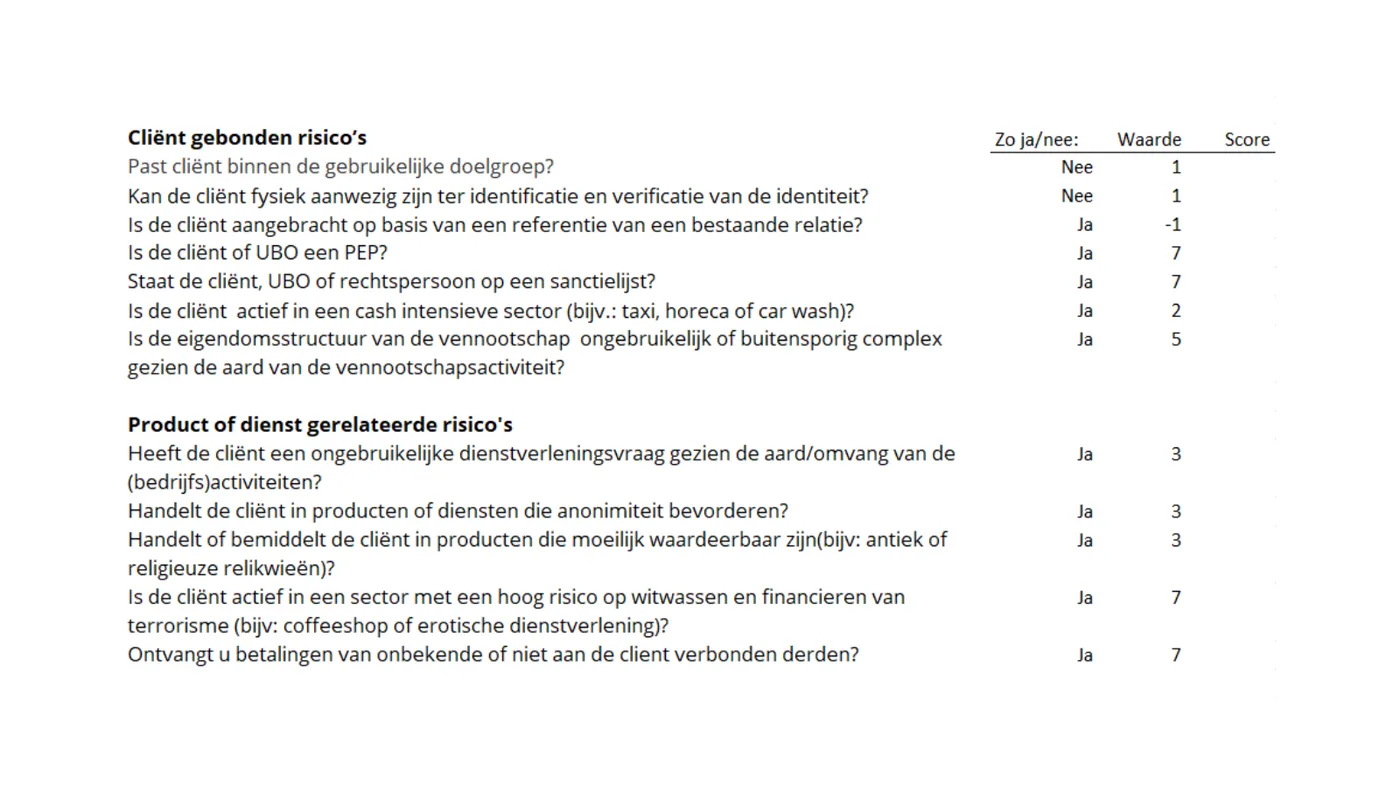
You may decide which risk factors apply when assessing your customer, aligned with the risks relevant to you and your business. To map these risks, we recommend creating a risk matrix such as the one below.
Collect for your file
- Completed risk matrix
Risk classification
After this thorough investigation of the risks, it is time to classify them. Under the Wwft, we use the following four levels:
- Low
- Normal
- High
- Unacceptable
Choose the applicable level and label the file accordingly.
Decision
Based on the customer due diligence, you must make a decision. Record whether you will enter into the business relationship. If there are high-risk aspects to consider, include them in your decision. In other words: despite risks relating to ‘example’, we will nevertheless enter into the business relationship.
Your decision should also include the rationale for monitoring and any actions needed to ensure that the risk does not materialise or, if it does, that it is identified promptly.
Collect for your file
- Your decision to enter into or reject the business relationship
- The risk classification
- The reasoning behind your decision
- Any action to mitigate the risk
3. Your file is now complete!
All the steps have been followed and your file is complete. Keep it for 5 years after the business relationship ends. If a supervisory authority ever visits, it may still request the file as part of its investigation.